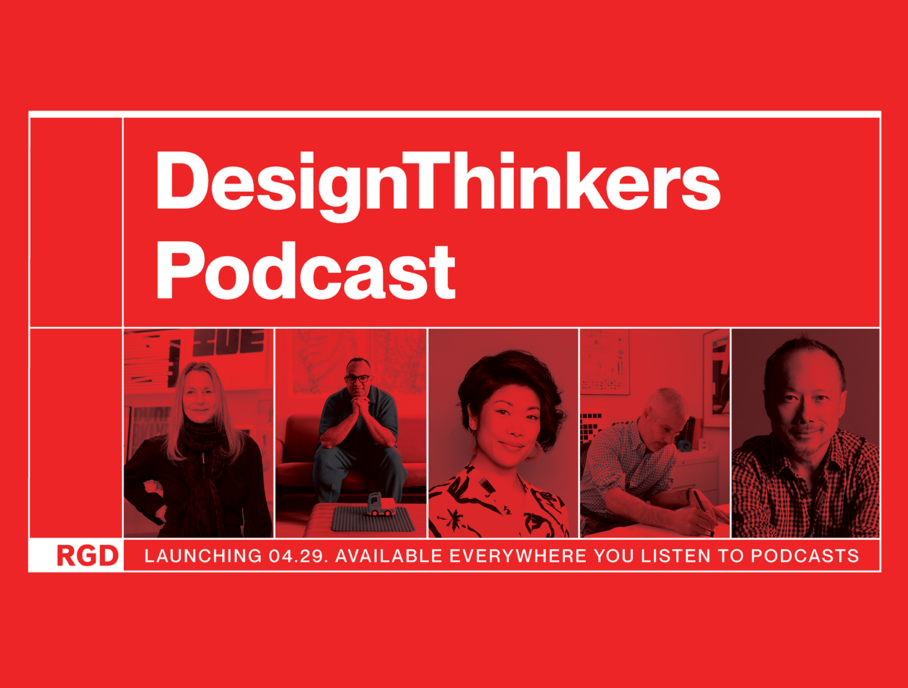
Introducing the DesignThinkers Podcast

To celebrate 25 years of DesignThinkers, the RGD is launching a podcast where we dig into the archives and reconnect with 25 past speakers about the talks and ideas that have shaped their careers, and our event.

Hosted by RGD President, Nicola Hamilton with branding, editing and coordination by Ashley Tomlinson Provisional RGD, the first episode featuring Paula Scher will premiere on April 29.

Featuring conversations with some of the biggest names to grace the DesignThinkers stage, in the podcast, they reflect on their careers and experiences at DesignThinkers in the recent and not-so recent past. Also included are audio clips of past talks.

“The list is amazing! All credit there goes to our Executive Director, Hilary Ashworth, who really outdid herself on the guest list. We’ve already spoken with Paula Scher, Lauren Hom, Annie Atkins, Brian Collins, Sagi Haviv, Ellen Lupton, Aaron Draplin, Forest Young, Erin Sarofsky, Michael Beirut, Steven Heller, Chip Kidd and Debbie Millman,” offers Nicola.

“Neither of us have been attending DesignThinkers from the beginning, so having an excuse to dig into the video archive was a treat. It’s a treasure trove of knowledge. We also really enjoyed speaking with past DesignThinkers Brand Partners for our bonus episodes. We’ve learned a lot about the history of the conference,” says Ashley. “We, as RGD Members and Canadian designers, are lucky to call this conference ours.”

“The long-standing relationships that the RGD has built with so many prominent designers on a global scale is really special. We had many speakers chat about how much they enjoy speaking at the conference. The RGD team works so hard to ensure that both attendees and speakers have an enjoyable experience,” adds Nicola.

A new episode releases every Monday starting April 29 with bonus episodes, featuring our past Brand Partners including Vanessa Eckstein RGD (blok design), Hans Thiessen RGD (Rethink) and Howard Poon RGD (DDB Canada), released on Wednesdays.

Subscribe to the DesignThinkers Podcast on all podcast apps, including on Apple and Spotify.

10 emerging designers win scholarships to DesignThinkers Vancouver

With the support of our sponsors, the RGD has awarded 10 cash scholarships to emerging designers to attend DesignThinkers Vancouver this May 28-29.

Student RGDs, Junior Affiliates and Provisional RGDs were invited to submit a 30-second to 1-minute video expressing their enthusiasm for DesignThinkers Vancouver and why they wished to attend the conference.

Each sponsor selected a winner and have provided $500 for them to help cover their costs to attend.

Thank you to this year’s DesignThinkers Vancouver Scholarship Sponsors: 123w, Becoming Design Office, OK DAVE, Pendo, PS&Co., Pound & Grain, Resonance, Rethink, Roodenburg Design and Will.

Below, we share their winning work. Click on each project to watch the video submission.

Alisa Luo Student RGD

Sponsor: PS&Co

Bella Sanchez Student RGD

Sponsor: OK Dave

Cherry Wu Student RGD

Sponsor: Becoming Design Office

Daniela Rojas DelaHoz Student RGD

Sponsor: Roodenburg Design Consultants

Garrett Poon Provisional RGD

Sponsor: Rethink

Jennifer Sutherland Student RGD

Sponsor: Pendo

Lauren Chien Student RGD

Sponsor: Resonance

Leen Bakri Student RGD

Sponsor: 123w

Madeline Belford Student RGD

Sponsor: Will

Merrielle DeGuzman Student RGD

Sponsor: Pound & Grain

The Scholarship program for DesignThinkers 2024 in Toronto will be announced in August.

If you would like to find out more about becoming a sponsor, email [email protected].

Talking project fails and the power of personality with SNASK

SNASK is a creative agency of misfit geniuses based in Stockholm, Sweden. In advance of their talk at DesignThinkers Vancouver, we asked SNASK execs Freddie Öst and Erik Kockum a few questions about agency branding, how to cope when projects don’t go to plan and more.

The SNASK brand is fun. It’s clear you endeavour to do things differently — with humour, with personality, with passion, and that ethos is evident in the projects you’ve worked on. How important is a studio’s own brand for attracting the kind of clients they want to work with?

This is a very good question. With our own brand, we never created it to fit or attract a certain type of client or audience. We simply made it the way we felt it resonated with ourselves as individuals. We were our own target group for the brand, because our purpose of having a company and agency was to build a vehicle to have fun, rather than a profit-making company. So everything that Snask is as a brand is what we ourselves would love from a similar brand.

Now, for the question, we strongly believe that an agency’s brand is very important, and of course attracting clients is, not the only, but certainly one of its major purposes. In the end, a human being is going to receive a message sent by another human being. So naturally we’re delighted when a human being at a company loves our values. We believe that more agencies should care more about their own brand and making it interesting. Most only care about the looks, trying to come across as minimalistic and professional, while most humans are attracted to an interesting personality with values, as well as a charming tone of voice. Who would marry someone for looks? It’s the way they make you laugh, cry and feel that are their most important aspects. Why not do everything in your power to make your future clients smile when they visit your website, social media etc.

Many design professionals work within constraints, whether it be small budgets, decision makers who don’t “get it” or ineffective work flows, especially in-house. Do you have any advice or insight for these designers who may be wanting to shake things up or push the envelope within this kind of environment?

We specialize in these matters, pushing through change in organizations from board level and all the way down to design and marketing teams. Things start at the top and trickle down, so if change is needed, and it is, you need to somehow get the top management involved. We often come in through a marketing director, but very quickly end up with the C-levels to help sell the purpose of change and turning a rebrand cost into an investment.

If you’re a designer working in-house and you need change, you should start voicing your opinion on this matter and speak in terms of the future costs of not changing in time. Management most often doesn’t understand the value of design or marketing, but they do understand the words cost, risk and also investment. It’s like being in a romantic relationship and seeing therapy as a cost. One needs to educate and convince the other partner that it’s actually an investment, and that the alternative of not going to therapy most likely will end in catastrophe.

SNASK’s project roster boasts some seriously creative, colourful and ambitious work. This is, of course, what we see on the outside, and as designers, we know there are often lots of ideas that never see the light of day. Can you tell us about a project that didn’t go to plan, “failed” or that you struggled with? How did you cope?

A lot of projects don’t go according to our vision. When this happens, we are open and transparent with the client and let them know that if we take this route, we will not case the project, meaning we won’t think it will be great enough to showcase on our website. However, we let them know that we can still make it look good, but for our portfolio standards, it won’t hold up. Sometimes they change their mind and go with our recommendations, sometimes they don’t. So we do have big projects that no one has ever seen, and that’s ok. They weren’t a catastrophe, but why show something that you’re not proud of. After all, what you have in your portfolio is what future clients will want you to do again. So if you put just “good enough” projects in your portfolio, clients will ask you to do just that.

As for a project that didn’t go as planned, we rebranded a huge financial player. It was a solid process all the way through until the founder and CEO stepped in. He had given the mandate to the marketing team to make brand decisions, and yet here he was wanting to have opinions on the new logo. The feedback was terrible, he couldn’t tell us what he didn’t like with the new logo, and he couldn’t tell us what he liked in other logos. It turned out that he had sent the new logo to his 12 closest members of staff. Who were they? 12 white men, within similar age, all having big salaries that depended on him liking them. So naturally, all of them told him they agreed that they didn’t like it. Since none of them had worked within design or brand strategy, they weren’t experts in these fields, and of course couldn’t back up their thoughts with rational arguments. In the end, all the work we had done was thrown out the door and the old logo was used instead.

A similar thing happened with another client, where the management team was asked about the company’s new symbol. None of them had expertise in this, and yet they were asked, so they had to give an opinion. Naturally, the feedback was horrendous. One of them said that the old symbol that was a cloud, was modern and shouldn’t change because their service was digital after all, and “in the cloud.” What he failed to understand was that services “in the cloud” is not even a thing, it’s expected and it’s probably the opposite. Companies that showcase that they are “in the cloud” are probably not that modern. In the end, we had to step in and have a long conversation with them where everyone could have an opinion, but had to be able to back it up with argumentation. After a few hours, we were back on track and could continue implementing the new visual identity with the new symbol. How we coped? We went to therapy.

Your DesignThinkers talk is titled, “F*ck the Conservative World!” Without giving too much away, what can attendees expect from your session?

It will be the opposite of conservative, so they will hear and see examples of being progressive, modern and open-minded. The thought of “let’s keep things the way they’ve always been” is absurd from the get-go. At what given time should we conserve things? Christmas 1995 when Dean Martin died? April 1960 just before the contraceptive pill was launched? It’s impossible to say a date when “things were better.” The world has changed, and we need to move on and concentrate on now and the future. And we’re now living in such a fast moving world that we need to embrace change and make sure it moves in the right direction. Focusing on what already happened won’t create change, it’s memories. So if we want to embrace change, we need to look forward, as it’s the only thing we actually can change.

People will also hear stupid things, wish they had a glass of red in their hand and will most probably need a smoke straight afterwards.

What are you most looking forward to about coming to DesignThinkers in Vancouver?

Wow, what don’t we look forward to! We’ve heard so many great things about Vancouver, so it’s hard to pick. First of all, being part of this great conference and hanging out with the audience. Then of course meeting with fellow speakers, many of them are dear friends to us. As for Vancouver, we will stay longer than the conference and explore your wild hiking trails. We won’t go on the “Fifty Shades of Grey-locations with wine tour” that we got recommended on Airbnb. Do crazy stuff like throwing snowballs, find a dealer of yellow margarine and share a pint with a sasquatch.

Catch SNASK’s talk, F*ck the Conservative World!, at 5:00 p.m. on May 28.

Attend DesignThinkers Vancouver for free

Student RGDs, Provisional RGDs and Junior Affiliates are invited to apply to win free attendance to DesignThinkers Vancouver. 10 scholarship packages are available, each including a free ticket and $500 cash to help cover the costs to attend.

To apply, submit a 30-second to 1-minute video expressing your enthusiasm for DesignThinkers Vancouver and why you want to attend.

Assessment

Applicants will be assessed on their creativity and passion. Priority will be given to Members who reside 100 km or more away from the location of the conference.

You must be a current Student RGD, Provisional RGD or Junior Affiliate Member to be eligible.

Deadline

11:59 pm PST on Monday, April 8, 2024

Thank you

These scholarships are generously provided by 123wBecoming Design OfficeOK DAVEPendoPSDDB (digital), Pound & GrainResonanceRethinkRoodenburg Design and Will.

Interested in supporting young designers? If you are interested in sponsoring a scholarship, email [email protected].

2024 In-House Design Awards now accepting submissions

The 2024 In-House Design Awards are now accepting submissions. The In-House Design Awards celebrate work done by creatives working internally in Canada and around the world.

The final deadline to enter is Friday, February 16.

All details are available on rgd.ca.

Whitman Emorson signs on as Design Partner for 2024

Joining the roster of esteemed firms who have developed branding for the DesignThinkers conferences, Whitman Emorson shares their design process, challenges, inspiration and more for the 2024 branding.

In its 25th year, the 2024 Conferences take place in-person with an option for online streaming in Vancouver on May 28-29 (registration opens Dec 2023) and in Toronto on Nov 7-8 (registration opens May 2024).

Why did you and your team want to take on the 2024 DesignThinkers branding as a project?
We took on the 2024 DesignThinkers branding project because of its significant impact on both the Canadian design community and our personal growth as individuals over the years. We are so lucky to have access to this kind of event so close to home and seeing all the studios who have contributed in the past is inspiring. Creating the conference identity also allows folks to get to know us at Whitman Emorson, our exceptionally talented team, our design philosophy and, of course, engage with the identity we’ve created! Plus, what a cool brief. It’s been freeing to step out of the parameters of our day-to-day and shake up our process to establish the visual identity for 2024.

What has been the most challenging aspect of coming up with the design/concept?
The most challenging part of this project/process has also been the most exciting! It’s a fairly open brief with fewer parameters than we’re used to (in this industry). Instinctually, as designers, we often thrive with structure, guardrails and restrictions. “Freedom within a framework” allows for play while being tethered — to explore, but not too far, to play, but within the sandbox. With the brief for 2024 DesignThinkers, we were challenged by the freedom of possibility and the endless ideas that come with it. Allowing ourselves to lean into a feeling of “anything is possible” was equally challenging as it was exciting.

We were also challenged knowing this visual identity would be viewed by our peers, both locally and internationally. Its reach and scale inspired us to create something that would resonate with the design community and the broader creative community, leading us to question: What is universally true? What will inspire and excite? What will be differentiated and how can we push our ideas/thinking/execution, all while having fun?

What is the source of inspiration for the concept? What research did you undertake?
Our source of inspiration for the concept stemmed from something that felt relevant to the design industry at large — the notion that embarking on any creative project can be initially daunting and overwhelming, often with uncertainty about where to begin, but ultimately, it is a fruitful and fulfilling journey.

Drawing from a range of influences, including surrealism, collages, graphic design tools and devices such as optical illusions, animation and textured layers, we were inspired by being immersed in the creative process ourselves. Our approach involved extensive visual research, employing tools like brainstorms, mind maps and mood boards. Ultimately, we aimed for the concept to capture and celebrate the dreamlike, unpredictable nature of the creative process, inviting attendees to enter into a world of endless discovery.

What has been your team’s design process to tackle this project?
We used this brief as an opportunity to shake things up and explore a new approach — nothing revolutionary but definitely different from our day-to-day. We briefed everyone on our team, including accounts, strategy and interns and conducted a studio-wide brainstorm. The session was inclusive and varied, yielding a wide range of themes and ideas! Designers were then paired up in teams, where each was responsible for coming up with creative directions and visual executions centred on a core idea or theme. We did quite a bit of research and narrowed in on three directions, two of which were shared with the RGD Design Committee. We were closely involved in the decision-making process and ultimately decided on, in our very humble opinion, an identity that we believe (and hope!) will resonate with attendees and speakers alike.

To learn more about sponsoring DesignThinkers, email Michelle Pereira Hampton, RGD’s Director of Communications & Development, at [email protected].

If you would like to submit a proposal to speak at the event, apply here.

General conference inquiries can be sent to Abdul Omar, RGD’s Programs Manager, at [email protected].

Over 2300 creatives came together in Toronto

While Paula Scher, at 75, declared that she is not done yet, Chris Do provided practical tools to master your next sales pitch — on November 2–3 the creative industry came together for our DesignThinkers Conference to celebrate everything design.

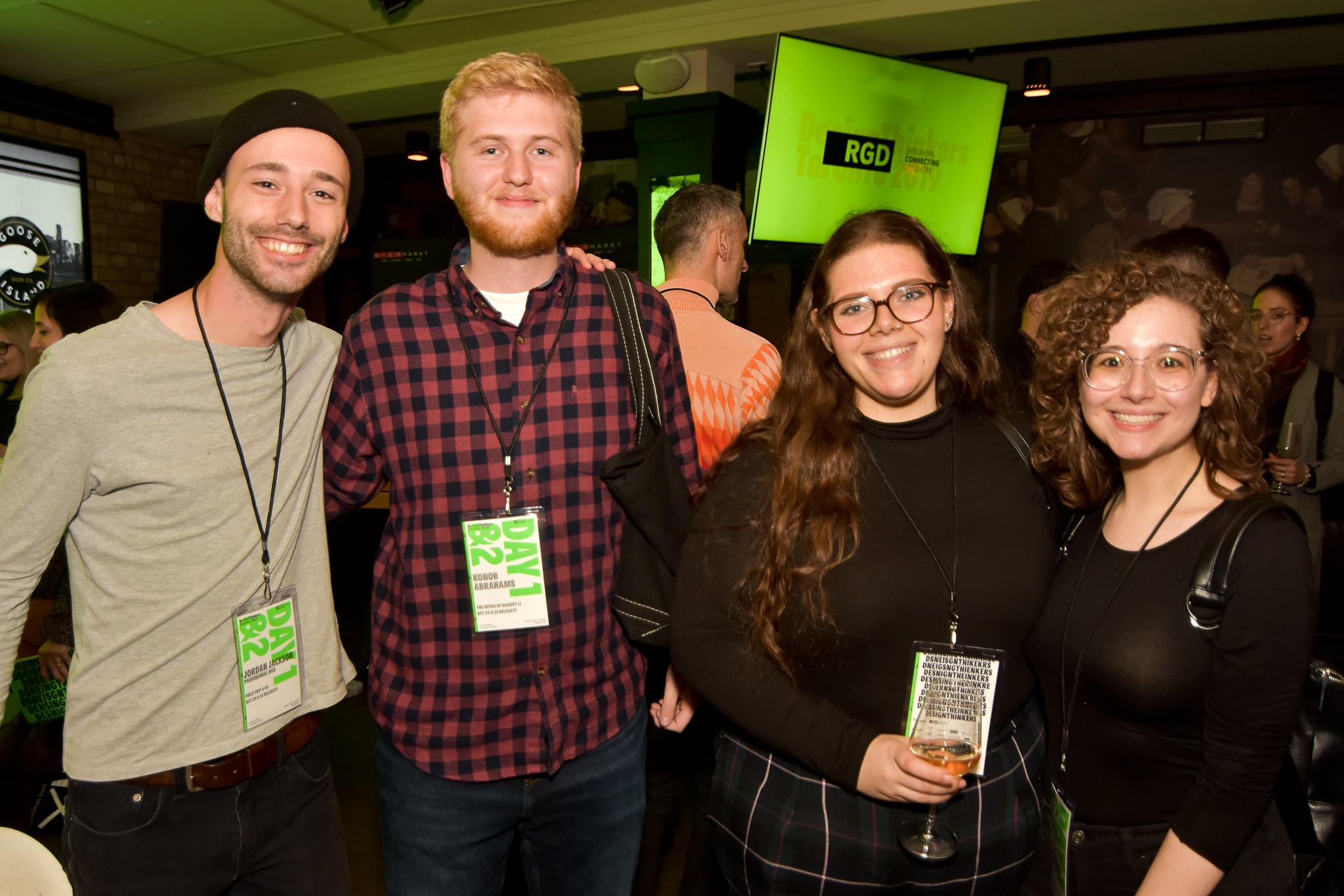
Hugs were exchanged, ideas shared and connections made — in what was our highest attendance ever; the energy was electrifying.

With an option to choose from three streams of talks, attendees also had opportunities to join studio tours and hand-on workshops, engage in conversations with peers on pertinent topics at the roundtable discussions, participate in speed networking and much more.

The conference also had the option for live streaming for those who preferred to attend from their home or office. All attendees have access to presentation recordings until the end of January, after which time they will be made available to RGD Members. You can still register to get access to the recordings on Pheedloop.

Pre-conference programming featured Accessibility Workshops by Meggan Van Harten RGD and Davide Dorigo Provisional RGD from Design de Plume, guided tours to leading creative studios in Toronto and a ceremony celebrating of the winners of the 2023 Branding Awards.

Day 1 of the Conference began with keynotes by Chris Do and Forest Young and featured talks by speakers who included Emmi Salonen, Farai Madzima, Noel Cottrell, Rejane Dal Bello, Renato Fernandez, Dalit Shalom, Paul Trani, concluding with delegates’ favourite talk by Paula Scher. Day 1 closed with a Party at Bier Markt, where delegates and speakers connected over delicious hors d’oeuvres, drinks and conversations.

Day 2 was packed with as much inspiration as the first with keynotes by Tina Roth Eisenberg and Eleni Beveratou and talks by Lauren Scully & Brian Studak, Min Lew, Catalina Estrada, Zipeng Zhu, Jay Demetillo, Dorothéa Bozicolona-Volpe, Krys Blackwood, Hajj Flemings, ending the day with a Keynote by Stefan Sagmeister. The day also featured a panel discussion on collaborative design workflows and a Never Have I Ever session with Stefan Sagmeister, Min Lew, Forest Young, Eleni Beveratou and Tina Roth Eisenberg hosted by Julian Brown RGD.

Delegates and speakers were invited to share thoughts on social media using the hashtag #rgdDT.

Registration for DesignThinkers 2024 Vancouver taking place on May 28-29 will open in December. Stay tuned!

Thank you for our volunteer photographers Nadia Otake Provisional RGD & Eric Forest RGD for day 1 and day 2 of the conference

Thank you also to Industry Partners: Adobe, Acumen (signage), Flash, Mohawk, Forge Media + Design (website) Porter (travel) and Sid Lee (branding); to Gold Sponsors Cella, CtrlPrint, Deloitte, Domtar, Monotype, Moveable, Rightsleeve, The Futur, York University School of Continuing Studies and Silver & Bronze Sponsors AZURE, Consulate General of the Kingdom of the Netherlands, Dalton Maag, Issues Magazine Shop, Mitchell Sandham, StickerYou, Swipe Design and WeirFoulds LLP.

Eleni Beveratou talks the future of type design

“For those involved in the creation of new media and platforms, it’s imperative to gain an understanding of how users engage with written communication and the critical factors that influence readability.”

Eleni Beveratou is a typeface designer and Creative Director at Daalton Maag. In advance of her keynote at DesignThinkers Toronto, we asked her a few questions about working in type design and how typography is evolving in our digital landscape.

Type is not only a fundamental aspect of graphic design, but also of written communication in general. What do you love most about working in this area of communication design?

It’s hard to choose, but my absolute favourite aspect is creating typefaces that span more than one writing system. Perhaps this is due to my Greek background, where I often see exceptional brand identities in the Latin writing system, particularly in English, which default to aesthetically poor or standard fonts when translated to other writing systems. When that happens, the impact of a brand weakens, which is disheartening. Therefore, when given the opportunity to create a typeface that transcends linguistic boundaries and resonates on a global scale, I feel that we contribute towards a more inclusive world.

Could you tell us about a typography trend or new application you’ve observed lately that has you particularly excited?

Type design currently finds itself at a crucial juncture, thanks to rapid advancements over the last five years or so. One development that particularly stands out to me is having typefaces that can seamlessly adapt to the light and dark modes in digital environments.

Nowadays, while users can choose to view the same content in light or dark mode, the way that typefaces interact with these backgrounds often gets overlooked. Black text on a white background will appear lighter than the same typeface at the same weight when displayed white on black. Our library typeface, Darkmode, tackles this very common UI issue, highlighting the critical role of type in the way that we consume content.

Digital platforms are changing the way we interact with content. How do you see the role of typography evolving in this landscape?

During this change, it’s crucial that we don’t repeat any mistakes of the past. The transition from print to digital environments led to many well-established typographic rules being overlooked, resulting in poor on-screen readability. This was largely because of a lack of research into reading habits and the craft of typography in print.

For those involved in the creation of new media and platforms, it’s imperative to gain an understanding of how users engage with written communication and the critical factors that influence readability. We must decide which reading habits of the past will be adapted, omitted, or replicated, and act accordingly with solutions like Darkmode that I mentioned above.

That said, your DesignThinkers talk is titled, “Typography in Digital Environments and Future Technologies.” Without giving too much away, what can attendees expect from your session?

Attendees can expect to hear me complain about how a bad typographic choice led to me missing a flight… All jokes aside, we will explore the world of typography and look at how it will manifest across future technologies, accessibility, and global reach. While we often focus solely on the visual aspects of typography, there is so much more to consider for effective, inclusive, and emotionally resonant communication for brands of all sizes.

What are you most looking forward to about coming to DesignThinkers in Toronto?

Toronto holds a special place in my heart as one of the first cities I visited in my current role. Even doing my research before arriving, I was struck by the city’s robust design community, showcased by an amazing comprehensive directory of all the design-related studios and individuals. I have yet to encounter such a thorough resource for any other city. Upon arriving in Toronto, the second thing that impressed me was its strong culture of knowledge-sharing among design peers. I can’t wait to hear more about good design, meet more passionate designers, and be part of such a strong community.

Catch Eleni’s keynote, “Typography in Digital Environments and Future Technologies,” on November 3 at 10:30 a.m. EST.

Seven emerging designers win scholarships to DesignThinkers Toronto

With the support of our sponsors, the RGD is awarding seven scholarships to emerging designers to attend DesignThinkers Toronto this November 2–3.

Student RGDs, Junior Affiliates and Provisional RGDs were invited to post work in response to the prompt, “The Future of Design.” They were also asked to submit written responses outlining why they would like to attend the conference.

Each sponsor selected a winner and have provided $500 for them to use to cover the costs to attend. Sponsors include BLVD, Cinnamon Toast, Davis, Frontier, Fusion Design Group, Office/Bureau and Pound & Grain.

Below, we share their winning work. Click on each project to learn more about it.

Eldhose Kurian Student RGD (awarded by BLVD)

A day in the life at DesignThinkers Toronto

As told by Olivia Montagnese Provisional RGD.

There’s no shortage of things to see and do at DesignThinkers Toronto. We asked Olivia Montagnese Provisional RGD, who has attended DesignThinkers nine times, what a typical “day in the life” at the conference looks like for her.

The doors are open. What are you up to?

On the first day of DesignThinkers, I like to arrive at the venue shortly after registration opens so that I’m able to thoroughly browse the supplier showcase booths and the giveaway table before it gets too busy. My friends try to get there around the same time as me so that we’re able to catch up, talk about what sessions we are excited to see, get breakfast and find good seats. Since there is so much excitement on the first day, arriving early and already having my schedule planned out helps me to feel more calm and ready for the busy day.

And lunch?

During lunchtime, my friends and I usually spend some time catching-up with other colleagues from the industry, and then we usually get lunch in together in the area.

You’ve watched a lot of DesignThinkers presentations over nine years! Any favourites?

There have been so many informative and memorable presentations, but some of my favourites that have resonated with me have been from Anton and Irene, Blake Howard, Emily Oberman, Aaron Draplin, Gemma O’Brien, Jessica Hische, Wade Jeffree and Leta Sobierajski, Vèronica Fuerte and Adam J. Kurtz.

I especially admire Timothy Goodman and Meg Lewis’s work, so it was such a special opportunity to be able to meet and chat with them.

Olivia and Timothy Goodman.
Olivia and Timothy Goodman in 2017.

The conference has more than just presentations, though. What do you do during your breaks and downtime?

During breaks, I usually chat with my friends, and visit the showcase booths, specifically spending a lot of time at the Swipe pop-up to hoard more design books 🤓

The delegate party is always a blast. How do you feel about it?

The delegate party is always such a fun way to end to the first day of the conference. Due to the pandemic, I’ve really missed it as the energy was amazing, and it gave me more time to catch-up with those in the industry that I don’t see often.


Olivia Montagnese (she/her) is a designer and artist based in Toronto. She’s interested in the arts and culture scene and hopes to shift perspectives and create unique and meaningful experiences through her work. She graduated from Humber College’s Graphic Design program in 2018, and currently works as a Designer at q30 design. When not designing, she can be found exploring new cafes and bookstores, taking film photos, curating playlists, and as of recently, taking pottery classes.